 how-to
Tips for Avoiding Overdone Filler Look
Table of Contents
- Start With a Consultation That Puts Your Goals First
- How to Talk to Your Injector About Natural Filler Results
- Signs of an Overfilled Face and What They Mean
- Go Slow: Why Small Amounts Beat Big Changes
- How Long for Filler Swelling to Go Down (and When to Judge Results)
- Natural-Looking Dermal Filler Results: What They Actually Look Like
- What to Do If Your Filler Already Looks Overdone
- Conclusion
- Frequently Asked Questions
Last Updated: October 15, 2026
Start With a Consultation That Puts Your Goals First
The best way to avoid an overdone filler look is to slow down before you ever book a treatment. A full consultation with a licensed provider should come first, every time. At Beyond Charms & Curves, we treat that first visit as a planning session, not a sales pitch.
Many people walk in with a photo of someone else's face. That is a common mistake. Your bone structure, skin thickness, and facial proportions are yours alone. A good provider studies your face before suggesting anything.
Here is what a solid consultation should cover:
- Your goals, in your own words
- Your medical history and past treatments
- A review of your facial anatomy and treatment areas
- A realistic timeline for results
- The risks and downtime involved
If a provider skips these steps and jumps straight to a needle, walk away. That is the single biggest warning sign of a rushed approach.
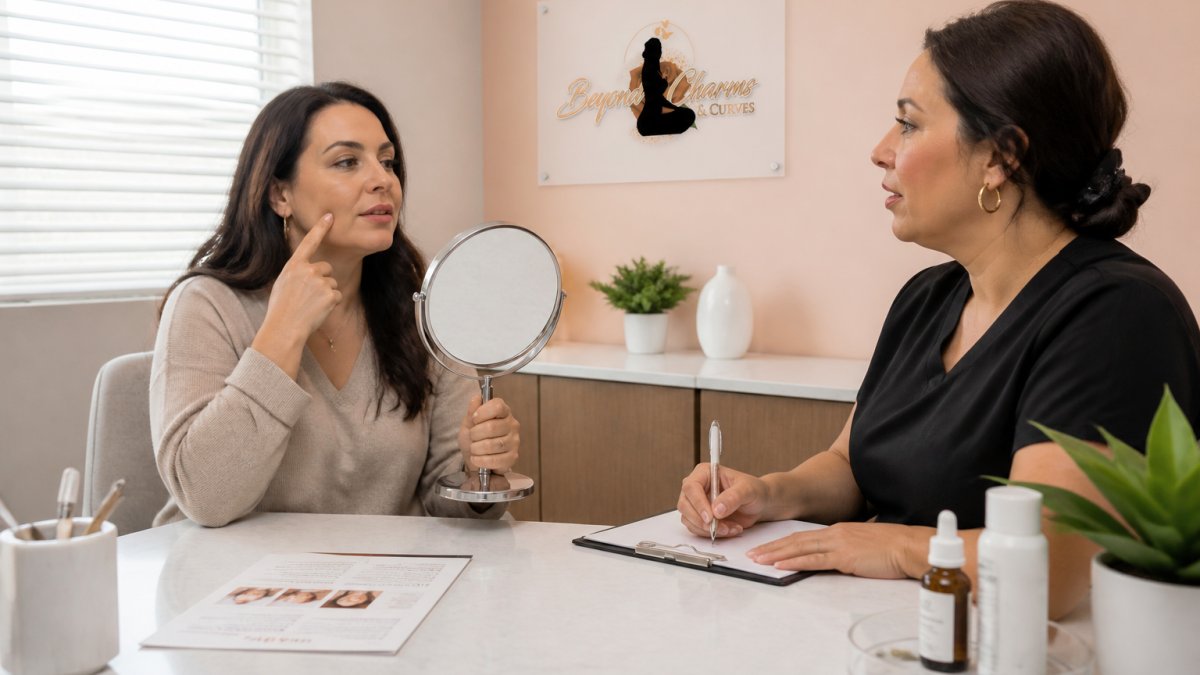
How to Talk to Your Injector About Natural Filler Results
Plain language works best when you talk to your injector about natural filler results. Say what you actually want, and say what you fear. Most people worry about looking "frozen" or overdone, and providers hear that concern all day.
Try phrases like these:
- "I want to look refreshed, not different."
- "Please start small and we can add more later."
- "Show me what you would do first, and why."
- "I would rather underfill than overfill."
A good injector will welcome these requests. They may even suggest treating one area at a time so you can live with the result before adding more.
Signs of an Overfilled Face and What They Mean
An overfilled face usually shows up as puffiness, heaviness, or a look that does not match your features. The tricky part is telling that apart from normal swelling in the first two weeks after a treatment. They can look almost identical on day three.
Here is a simple way to think about it. Swelling is temporary and usually peaks in the first 48 to 72 hours. Overfilling is a volume problem that stays put once the swelling clears. If your face still looks inflated at the two-week mark, that is a different conversation than day-two puffiness.
Watch for these changes once swelling has settled:
- Cheeks that look inflated or pillow-like from the front and the side
- A heavy, drooping mid-face that pulls your features downward
- Lips that sit too far past their natural border, especially the upper lip
- Skin that looks tight or shiny over the filler, sometimes with a waxy finish
- A face that looks fuller than your body, so your features stop matching your frame
- Loss of the natural shadows under your cheekbones or along your jawline
People sometimes call the later stage "filler fatigue." It happens when product builds up over repeated sessions without enough time between them. Hyaluronic acid filler also attracts water, so each syringe can look like more than its stated volume once it settles. Add a little every few months, skip the review appointments, and the face slowly stops looking refreshed and starts looking done.
A common pattern practitioners see is what some call "pillow face": a rounded, puffy mid-face with flattened cheek contours and a slightly wider lower face. It rarely comes from one treatment. It builds.
The good news: mild cases often settle as swelling fades. More advanced cases may need a different plan, and the next section covers what that looks like.
Go Slow: Why Small Amounts Beat Big Changes
Small amounts of filler, spaced over time, give the most natural-looking results. This gradual approach is the closest thing to a rule in aesthetic medicine. Big single-session changes rarely age well.
Hyaluronic acid fillers attract water and can shift slightly as they settle. If you add a large volume at once, you cannot easily predict the final look. Add a little, wait, and assess. That way you stay in control.
A conservative treatment plan often looks like this:
| Visit | What Happens | Why It Helps |
|---|---|---|
| First session | Small amount in one area | Tests how your face responds |
| Follow-up (2-4 weeks) | Review and touch-up | Lets swelling fully settle |
| Later sessions | Gradual additions | Builds volume without overfilling |
One honest drawback: going slow takes patience and more appointments. If you want a dramatic change for a single event, this pace may frustrate you. For most people, though, the trade-off is worth it.
How Long for Filler Swelling to Go Down (and When to Judge Results)
Most filler swelling fades within a few days, but full settling can take up to two weeks. Do not judge your results on day one. That is when swelling is at its peak and everything looks bigger than it will be.
A rough timeline:
- Days 1-3: Peak swelling, possible bruising
- Days 4-7: Swelling drops, shape starts to show
- Weeks 2-4: Final result becomes clear
Your provider should schedule a follow-up appointment to check how things settled. This is your chance to ask for small adjustments.
Talk to your injector about aftercare. Common guidance includes avoiding intense exercise, alcohol, and blood-thinning pain relievers for the first day or two. Cold compresses can help with swelling.
Natural-Looking Dermal Filler Results: What They Actually Look Like
Natural-looking dermal filler results are subtle. They restore volume and soften lines without changing who you are. Most people will notice you look well, not that you had work done.
Here is what to aim for:
- Balanced facial proportions, not bigger features
- Smooth transitions between treated and untreated areas
- Movement that still looks like you when you smile
- A refreshed appearance, not a new face
The right product matters too. Thicker fillers support structure, like the cheeks and jawline. Thinner fillers work better for fine lines and lips. Your provider picks based on the treatment area, not a one-size-fits-all rule.
Filler types also differ in how long they last and whether they can be reversed. Hyaluronic acid fillers can be dissolved if needed, which is a real safety advantage. Other filler types cannot.
What to Do If Your Filler Already Looks Overdone
If your filler already looks overdone, you have options, and the first step is a calm conversation with a qualified provider. Do not panic, and do not rush to add more product to "fix" it. Adding volume to balance volume is how faces end up looking heavier.
Start by giving it time. Mild puffiness often fades on its own within two to four weeks as swelling resolves and the product settles. Take front-facing and side photos in the same light every few days so you can see the trend instead of judging one bad morning.
If it still looks overdone after that window, here is what a provider may walk you through.
1. Wait and reassess. Some filler settles lower or softer than it first appears. A review appointment at the two-week mark is the right time to decide.
2. Dissolve it, if the product allows. Hyaluronic acid (HA) fillers can be broken down with an enzyme called hyaluronidase. This is a real advantage of HA products. It is not instant and not risk-free. A provider typically starts with a small test dose, watches for a reaction, then treats in stages over days or weeks. Over-dissolving can leave hollowing, so most practitioners go slowly.
3. Understand what cannot be dissolved. Fillers made from other materials, such as those containing calcium hydroxylapatite or poly-L-lactic acid, do not have a reversing agent. They are broken down by the body over time, which can take many months to a couple of years depending on the product and the area. If you are not sure what you were given, ask for the product name and lot number from your original injector. That record matters.
4. Change the plan, not just the dose. A new provider may switch products, treat a different area, or stop treating an area altogether. Sometimes the fix is subtraction, not addition.
Before any correction, evaluate the provider beyond a license check:
- Are they licensed and trained specifically in injectables, not just general practice?
- Do they ask for your treatment history and product names before suggesting anything?
- Do they keep hyaluronidase on site and know how to use it?
- Do they have a written plan for complications like vascular occlusion?
- Do they offer a review appointment as part of the treatment, not as an upsell?
A provider who welcomes these questions is a good sign. One who brushes them off is not.
The safest path out of an overdone look starts with an honest assessment from a licensed provider, not another syringe. Ask what product you have, whether it can be dissolved, and what the realistic timeline looks like before you agree to anything.
Conclusion
Avoiding an overdone look comes down to three things: a real consultation, small amounts, and patience between visits. The right provider will listen, plan, and move at your pace. At Beyond Charms & Curves, our customized treatment plans and physician-guided approach are built around natural-looking results, using FDA-cleared devices and professional-grade skincare lines. If you want to look refreshed without looking done, book a consultation with our team and start with a plan made for your face.
Frequently Asked Questions
How long does it take for fillers to stop looking lumpy?
Mild lumps or bumps are common right after treatment and usually settle within one to two weeks as swelling goes down and the product integrates with your tissue. If lumps persist beyond two weeks, feel hard, or are visible when you smile, contact your injector. They can assess whether massage, time, or a follow-up adjustment is needed. Never massage the area on your own unless your provider specifically tells you to.
Can dermal filler be dissolved if I do not like the result?
Hyaluronic acid fillers, the most common type, can be dissolved with an enzyme called hyaluronidase. This is one reason hyaluronic acid fillers are considered more forgiving than other types. If you are unhappy with your result, a qualified injector can evaluate whether dissolving is appropriate. Fillers made from other materials, such as calcium hydroxylapatite or poly-L-lactic acid, cannot be dissolved the same way and must be managed differently.
How can I explain that I want subtle, natural-looking filler results?
Be specific about what you want to change and what you want to keep. Bring a photo of yourself from a few years ago rather than a celebrity photo. Say plainly that you want to look refreshed, not different. Ask your injector to start with a small amount and schedule a follow-up in two to four weeks. A provider who listens will welcome this approach and build a plan around your comfort level.
Should I wait before getting more filler if my results look uneven?
Yes. Swelling after filler can take one to two weeks to fully resolve, and the final result often takes a few weeks to settle. Unevenness during this window is usually temporary. Wait at least two weeks before deciding whether you need more product. Adding filler too soon to fix perceived asymmetry is a common path to overcorrection. Schedule a follow-up appointment so your injector can assess the result properly.